Invest in your future, then invest in your world.TM
The original tree plantation of Finca Leola is located in La Garita, near Monterrey, San Carlos, Costa Rica. This is where we grow teak, because the altitude and dry season are suitable, and the land in this area is very rich volcanic soil. It is located within 20 kilometers of Arenal Volcano, one of the most popular tourist destinations in Costa Rica. Forestry engineer Antonio Rodriguez examined the property and said that it is some of the richest soil he has seen in Costa Rica in his 20-plus-year career. Antonio has been working with hardwood plantations for many of those years, and we consult with him on an ongoing basis. Our second plantation, near Guatuso, is ideal for many natives.
Finca #1 used to be a working dairy farm. The property had only been a farm for about 30 years; before that it was rain forest. Because of this, the land has about 50 cm of the richest topsoil. The farmer did an excellent job of not overgrazing the land. Antonio expected superior growth rates due to the richness of the soil, and his prediction has been borne out by the excellent growth rates we are experiencing.
The finca is roughly 400 feet above sea level, which is an excellent elevation for growing teak. The land is very well drained. It is approximately 67 hectares, or 165 acres. It is 1 kilometer from a nationally maintained dirt road and 7 kilometers from a paved road. Even during the rainy season, you can drive to the finca without four-wheel drive — though four-wheel drive sure makes it easier.
We choose properties based on these factors:
 |
Location — We focus on the foothills and lowlands nearest the central mountain range near Lake Arenal. The land in this area is known in Costa Rica as being some of the most fertile. This means that our conservative estimates on growth rates of trees are being exceeded. (In addition, those who own trees with us can visit Arenal and Monteverde during trips to see your trees, as our farm is about 1 hour north of La Fortuna.)
|
 |
Access — Some of the properties we visit are very difficult to get to during the rainy season, though this could be remedied with road work. We deliberately search during the 8-month rainy season so that we can evaluate how bad access is then. The fincas we choose have not only the best soils, but year-round access.
|
 |
Water — Another advantage of checking out land during the rainy season is to determine how well-drained the soil is. Our fincas have excellent drainage and are well-supplied with water by rivers and streams intersecting the properties. Also, because the topsoil is so deep, it holds water very well for the dry season.
|
 |
Soil — As has been mentioned, the soil in this area is excellent. A preliminary soil test of our first finca showed 50 cm (20 inches) of volcanic topsoil. 25 cm or more is considered excellent for growing trees. More complete soil tests established that the land requires very little fertilizer.
|
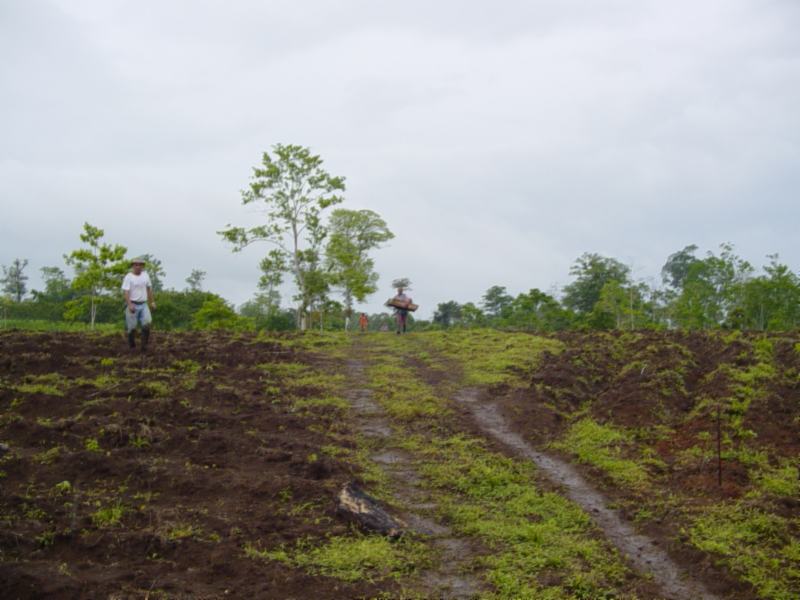
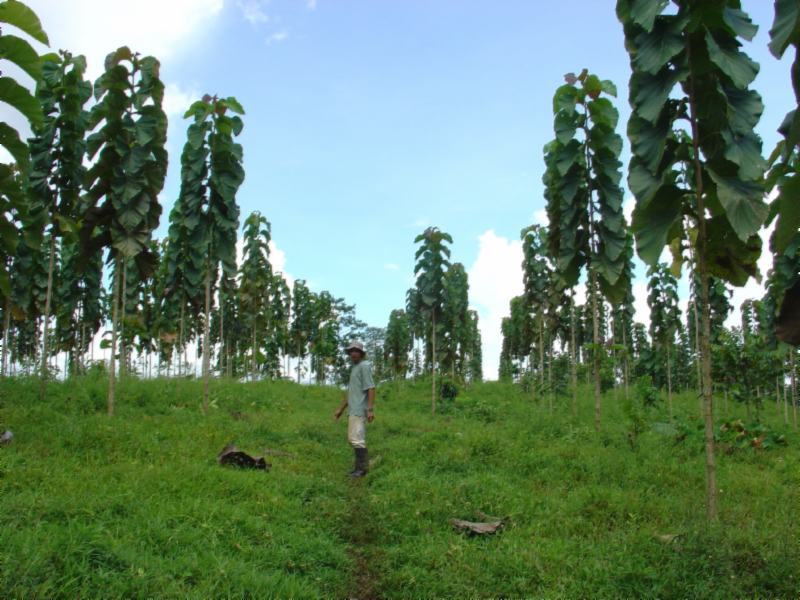
We are extremely pleased with the results of planting hardwood trees on this land. The trees are growing very well (see the photos below and our newsletter), and we are very excited about the future.
 This is the same field in July 2003 and in October 2004.
The partners of Finca Leola decided to allow others to own trees on our plantations and so began to sell trees to people who want to participate in reforestation. Why are we doing this? Honestly, we don't need to. We could plant enough trees for ourselves to do all the things we want to do in our retirement and leave a legacy for our families. But by extending the operation to include planting trees for other people, we can help the world both by bringing back more tropical hardwood trees and by preserving a significant part of the land in its natural state. We also have the local community in mind. Growing trees for more people means more jobs there and possibly more revenue for the local farmers from land sales.
The following are our reasons for opening up this opportunity.
 |
Many of our friends are looking for a better investment than the stock market. It becomes very hard to save for your retirement if you are getting no returns, or worse yet, negative returns. We believe strongly enough in the increasing value of tropical hardwoods that we are investing in them for our retirement. And yes, you can own trees in your IRA or other qualified plan.
|
 |
There is so much excellent, beautiful land nearby, and we would like to help protect it. By offering to grow trees, we are able to purchase these lands and protect many of the wild areas. Up to 60% of the land we purchase will be left wild and not used for plantations. This will allow the return of jungle that will create biological corridors that will help preserve the indigenous flora and fauna of the rain forest. Eventually, even the plantation land will become perpetual forest.
|
 |
To live in or retire to Costa Rica is a dream for many. Buying trees with a registered reforestation project makes it possible to apply for residency in Costa Rica after a minimum amount has been reached, and that amount can be accumulated over years.
|
 |
There are many people who would honestly like to be able to help reverse the trend of deforestation, but cannot seem to be able to save for their children’s education and their retirement and still have any money left over. We believe that, by offering to grow trees for others, we are making it possible for them to help and still meet their very important obligations. It seems very fitting that someone could invest in their children’s future education and their future on the planet at the same time.
|
 |
Diversification is a very good thing. One of the reasons we ourselves decided to invest in reforestation is to diversify our investments. |
Notice: We are not financial advisors, but are willing to share with you our information sources, experiences, and observations. It is up to you to do your own research and evaluation to determine if you wish to invest in any reforestation project.
Up |